

He travelled the world, visiting both exotic and remote places, capturing images for many of the biggest brands on the planet. This is the exceptional story of a fearless Dutch photographer with a zest for life during the golden era of photography.
In this book, Leen Thijsse (1959) presents a vast collection of his award-winning commercial campaigns, impressive landscape photography and free and intuitive work. More than a visual chronicle of his thirty year career, ZEST is a time capsule, a window into different worlds and a dialogue between the past and the present.
The following content contains a brief summary of the life and carreer of Leen Thijsse and are published in the printed book - All rights reserved.

“A photograph seeks its photographer like a book chooses its author. Therefor I believe my photographs were given to me.”
FORWORD
"Leen Thijsse rode the perfect wave of the advertising era, leaving an indelible mark on the industry."
A VISIONARY LANDSCAPE PHOTOGRAPHER
From the early 1980’s through the late 2010’s, my partner Bill Stockland and I, Maureen Martel, navigated the golden age of advertising with our agency, Stockland Martel. We represented some of the world’s most renowned photographers, bringing conceptual advertising to life on a grand scale.
In 1989, as the industry sought a landscape photographer who could subtly manipulate scenes to captivate viewers, we discovered Leen Thijsse. A Dutchman with a passion for travel and a keen eye for details, Leen quickly became a standout in the field. His work echoed the classic Dutch landscape painting with vast skies and beautiful cloud formations that left a lasting impression on our clients. Leen’s technical prowess and collaborative spirit made him a joy to work with. He created award winning campaigns around the globe, always delivering results that were as breathtaking as they were innovative. Even as the industry transitioned from traditional photography to negotiating digital asset deals, Leen’s legacy as a trailblazer in commercial photography remained strong.
Leen Thijsse rode the perfect wave of the advertising era, leaving an indelible mark on the industry and on all of us who had the pleasure of working with him.
Maureen Martel & Bill Stockland - Stockland Martel
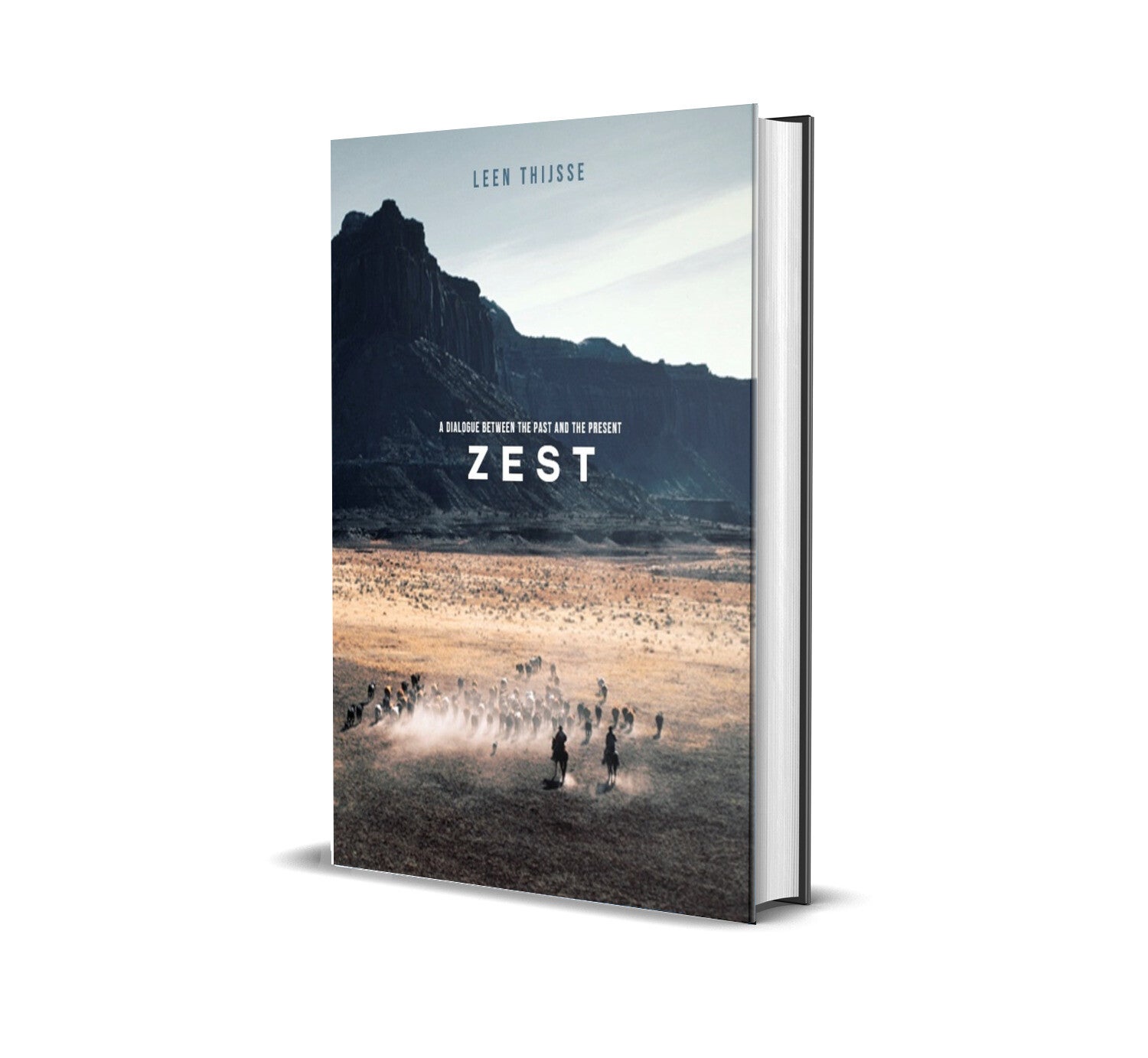
ZEST was created with the dedication of the following contributors:
Photography Leen Thijsse
Post production Edwin Veer
Design Jaap van Ens
Concept & Text Bart van Tongerlo
Text Editing Natasha Hawkes
Available in three sizes:
SMALL: 21 x 28 cm
MEDIUM: 34 x 47 cm
LARGE: 45 x 60 cm
THE PROMISE
Leen’s passion for photography was ignited when he stumbled upon a little brown suitcase that had belonged to his uncle. Adri van der Ende, his mother’s brother, was a handsome young man with blonde hair and blue eyes who had enlisted in the Royal Netherlands East Indies Army (KNIL). Tragically, he never returned from Indonesia, passing away before the war officially started, likely from food poisoning. The only remnants of his life were a handful of photographs and drawings.
Leen became mesmerised by the black-and-white images, capturing the landscapes and life in the
Dutch East Indies. These snapshots of another world, as well as Adri’s fate, left a profound impression on Leen. “Every time my mother saw me looking into the suitcase she cried and told me stories. She didn’t know where her brother was buried. I became fascinated by this tragedy.”
Leen promised his mother that one day, he would travel to Indonesia and find her brother’s grave. Years later, that promise led him to the harbour of Surabaya, as the drawings and photos from Adri’s
collection beckoned him to uncover more. Leen, staying in an old colonial-era hotel to recapture the atmosphere of the time, delved into his search for traces of his uncle’s final resting place. Leen sought help from the hotel receptionist, who promised to ask his father for information. The next morning, a modest, kind Indonesian man who spoke fluent Dutch led him to the registry at a Dutch colonial cemetery. One of the old photos from Adri’s belongings revealed scenes from his funeral, showing soldiers and friends carrying his coffin. With this clue, the man directed Leen to the
Kempang Kuning (Yellow Mountain in Javanese), a war cemetery that seemed to match the images. Leen’s Dutch-Indonesian girlfriend arrived the next morning, and together with their guide, they set off. When Leen offered payment, the guide refused his offer and replied: ‘If someone comes to Indonesia to find their lost family, it is an honour for me to help.’ In the old photographs the location looks like a nice site in an empty landscape but when they arrived, it was unrecognizable. The slum that had grown around the cemetery made the search difficult, but with the help of local residents, they uncovered a memorial stone in the overgrown grass. The name emerged from the stone: ADRIANUS VAN DER ENDE.

When he returned home from his quest his mother and one of her last living brothers were waiting for Leen to show them pictures of the grave. “They embraced me and I felt like the three of us were flying. It was as if my uncle could finally move on into the afterlife, but I’m not sure about such things. However it was an incomparable emotional experience and it improved the relationship with my mother.” Leen passed on all the information to his mother, and later, Adri was reinterred in the family grave in The Hague. Leen had fulfilled his promise. Years later, a clairvoyant friend tells him: ‘There’s a handsome man with blue eyes standing behind you, wearing a white uniform.’
“Throughout my entire career, I’ve felt a connection with him. As if he was guiding me from another
world.”
THE LIGHTHOUSE
Leen Thijsse grew up as the youngest of seven children in the Dutch fishing village of Scheveningen, where traditional clothing was still a part of daily life. The family home was always bustling, not just with his parents, two sisters, and four brothers, but also with visitors like the local accountant, a truck driver, or a mechanic, who often joined them for meals. “During prayer, I always had to stab my fork into the meatball, or one of my brothers would steal it from me.” Their home was situated above the office of his father’s trucking company, which he had inherited. Behind the house there were stables and sheds where horses, chickens, dogs, cats, and doves and donkeys roamed freely. “Though we lived in a fishing village, it felt a lot like a farm.”
As a child, he would play outside the house, gazing out at the fishermen and ships in the harbour. At night, he would listen to the wind rattling the masts, as the lighthouse’s beam projected both creative images and frightening shadows through his bedroom curtains on the walls. “One time, in the middle of the night, a whirlwind blew my balcony doors open. I had tied them to my bed with the cord of my bathrobe. So there I was, standing with my bed in the rain on the balcony.” Leen’s family lived close-knit lives. His uncle was their next-door neighbour, and his grandfather had built the six houses along the street that led to the yard, back when the area was still dominated by sand dunes, before the harbour was constructed. Around the corner lived his grandmother and one of his aunts. By the time he was twelve, Leen was spending Wednesday afternoons cleaning trucks in the yard, and even learning to drive them from the harbour to the washing station. He also picked up skills in welding, engine repair, and spray painting. School held little interest for him; he preferred working with his hands, a skill that would serve him well later in life. His homework was often done by his brothers.
As he grew older, Leen began accompanying the truck drivers on weekends and school vacations, delivering fish and other cargo to Belgium, France, and Germany. His mind wasn’t set on academic success or even climbing the career ladder. What Leen really craved was experience—especially the
chance to travel. Eventually, photography would become his gateway to seeing the world, offering him a unique perspective through the lens of his camera. “Photography was unknown to me but I always had stacks of travelbooks and I was fascinated by the art of printing.”
OPEN-AIR STUDIO
At fifteen, Leen moves with his mother to their new summer home in Kootwijk. “We spent every holiday there; my mother said it was impossible to drown on that endless expanse of sand.” Her fear was deeply influenced by a traumatic event from the end of the war—one of the last German V2 rockets, intended for Britain, tragically misfired and landed on Dutch soil. ”My grandfather, one of my mother’s brothers, and his two sons were killed.” Leen’s father, who had miraculously escaped a German labour camp during the war and walked back to The Netherlands, commutes between Scheveningen and Kootwijk on weekends. Leen finds the adjustment difficult, missing the dynamics of the industrious life at the family yard. Yet, with a young photographer’s curious eye, the endless sand dunes become his own open-air studio: a perfect backdrop for experimenting with light, landscapes, and female beauty.
Leen and his girlfriend move into a converted outbuilding on the estate—a former sheepshed. He clears out the manure and refurbishes it himself, all whilst building his photography portfolio. “For one erotic series, I did a test shoot with an Asian model. I tried using a lace curtain, but it wasn’t working. Since I lived nearby, I grabbed a bucket of water instead and made the curtain wet. The erotic and also mystical atmosphere worked out well.” When a curious American agent later asked, ‘Where did you shoot this, Vegas?’ Leen chuckled. “Later I shot a series on the pink coral sanddunes for an American advertising campaing, Corning. I realised there is always a connection between the past and the future.”
GOING TO WHITEHORSE
At just seventeen, Leen sets off on an adventure, travelling like a nomad for almost a year as he hitch-hikes across the United States and Canada, bound for Alaska. His journey takes him to Whitehorse, a remote Canadian city and the northernmost stop on the Greyhound Express. After being stuck by a snowstorm for three days in Whitehorse, he secures a ride to Anchorage, Alaska. Alongside two fellow travellers, they take turns keeping the truck driver awake as they pass through a surreal landscape.
When his funds start running low, Leen hitch-hikes to Whitehorse to catch the Greyhound back to New York. It is here, in the bustling city, that his love for the Big Apple began to emerge. However, when he attempts to collect his return ticket to Amsterdam, he discovers that the travel agency has gone bankrupt. Desperate, he heads to the Dutch embassy for help. As he waits, a taxi driver with long, hippie hair—who bears a resemblance to Leen himself—asks him where he’s heading.
‘Rockefeller Center, but I’m out of money,’ Leen admits.
‘Get in,’ says the driver, who once hitch-hiked across Europe himself. ‘You can’t walk there with a heavy backpack.’
Leen contacts his brother in The Netherlands, who manages to secure a first class ticket for him. After days of sleeping in the aisles of musty, crowded buses filled with smelly backpackers, the other people looked surprised to see the long-haired, smelly young man in first class. For Leen this luxurious end to his overseas adventure was an unexpected surprise.
MEADOW AND COWS
After his sabbatical, Leen accepts a job at the Rotterdam harbour—a mundane office role that comes with one exciting benefit: free ferry rides to Hull. In England, he travels by train, indulging in photography and savouring the freedom of the road. After six months of shuffling paperwork for freight shipments, Leen leaves the harbour behind and returns to Kootwijk, where he opens a lively bar with some friends. But soon, the pull of travel calls again. He partners with one of his bar companions to start a business importing bicycles from Brazil. The venture falters when negotiations with the Brazilian mountain bike manufacturer fall through. In truth, Leen is far more captivated by photography than shipping Brazilian vases, candles, or bicycles through customs.
He gradually finds his way into the golden era of photography, and the first steps toward a successful career begin to take shape. Frank de Jongh, a friend and photographer, introduces Leen to the basics of black-and-white printing. Leen starts assisting photographer Willem van Leuveren in the darkroom, developing and printing promotional photographs of Volkswagens for Ben Pon, the largest Volkswagen importer in the Netherlands. It is a unique experience. “I’d get up at the crack of dawn, drive to the studio, and spend the entire day in the dark, enveloped by the sharp smells of chemicals. By the time I finished and headed home, it was already dark outside. But it made a lasting impact on me—I felt like a magician.”
At the same time, Leen begins taking artistic photos of his girlfriend, earns some money and buys his own camera equipment. His darkroom experience leads him to assist a photographer who rents a studio from photographer Geek Zwetsloot at Lindenstraat 44 in Amsterdam. When the owner moves on, Leen takes the opportunity to buy the studio at a good price. This marks the beginning of his journey to build a proper portfolio. His network expands, and he starts working as an assistant for renowned photographers such as Jan Francis, Aernout Overbeeke, and the British photographer Brian Morris. “Morris’s table setups—beer shots, food, flowers—weren’t really my style. But what I learned from him was invaluable: you don’t have to master every skill yourself. You can hire others and build a strong team around you. Morris gave me the confidence to fully follow my own path.”
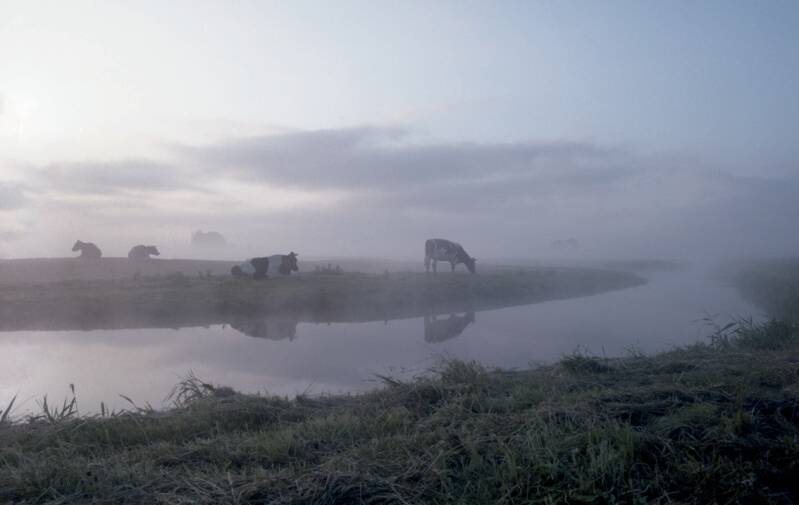
Leen showed his series Cows in the Mist with Brian Morris, who liked the prints so much that he bought them and hung them in his Amsterdam home. A few weeks later, Leen gets fired. ‘I can’t teach you anything more’, Morris said. ‘Go and do what you really want to do.’ Later his photographs of meadow and cows became his gold card to an exceptionally successful career.
He also learned a great deal from Jan Francis. Francis was a talented fashion photographer who worked in Milan, Paris, London, and New York. Their lifelong friendship was cemented by the fact that their work was so different from one another’s. “I owe Jan a lot. He gave me an incredible opportunity through his connections. It helped that I was creating something entirely different from him—he was shooting fashion models, and I wasn’t.” Francis eventually moved to New York, where Leen would visit him regularly. During one of these visits, Francis asked him, ‘Why don’t you find an agent here in New York?’
THE SUN DANCE
A typical Dutch landscape gives way to a very different scene: the Wild West. Leen is working in his studio on Lindenstraat in Amsterdam when he receives a call from John Boyler, a junior art director of Wieden & Kennedy—his first assignment for America to promote tourism in Oregon, and for that, Leen is flown over to photograph a Native American. “It really was the Wild West there. The Native American they chose had appeared in multiple Western films. His face was incredible.”
But, three days pass and Leen still hasn’t captured the shot he’s waiting for. The weather refuses to cooperate and frustration begins to set in. Sensing the growing impatience, the Native American approached Leen that evening, and with quiet confidence he said, ‘Tomorrow morning, you’ll get your shot.’ Then, he performed a sun dance. The following morning, the crew arrived before dawn. Trusting in the Native American’s intuitive timing, Leen prepared his camera. “Suddenly, the sun broke through the clouds. For about half an hour, the light was absolutely stunning, casting a golden glow over the Native American and the photographs on the 4x5 Polaroid were beautiful. And then... it began to rain.”

Leen nailed the perfect shot, which would later be used in a massive panoramic billboard advertisement. It felt like more than just luck. It felt like a gift from above. From that moment, Leen realized that he didn’t just take photos; he receives them. This marks the start of an extraordinary career, with one monumental project after another for global brands like Renault, Audi, FedEx, Kikkoman and Bank of America. He even served as Tiger Woods’ personal photographer for three years and captured a helicopter shot over the Twin Towers—a photo that would later take on a profoundly different significance.
It would not be the only time that seemingly inexplicable events of great significance and prophetic character happen to Leen. He continually receives pieces of a puzzle depicting the course of his life, particularly during encounters with predominantly Indigenous people like a Mexican elder of an almost hidden tribe around the year 2000. After a car shoot for Jeep in New Mexico, Leen is called upon by the chief. In a ceremonial manner, he hands Leen a medium-sized bow and arrow. ‘This is for protection’, the chief whispers to him, instructing Leen to hang the object above the entrance of his house. A gift that would later take on another different significance.
"ON YOUR WAY, EINSTEIN!"
Jan Francis introduces Leen to his agent Glenn Palmer Smith, an influential figure in the photography industry. ‘This is a beautiful portfolio’, Palmer Smith tells him, ‘but cows in the mist and naked women in the desert... I’m a fashion rep; that’s not really my area.’ Still, he is willing to show Leen’s work to a colleague, and soon, Leen and Jan Francis are invited to an estate in Upstate New York. There, they meet Glenn Palmer Smith, along with his girlfriend, a woman who looks uncannily like Meryl Streep.
The evening is full of wine and laughter, and the next morning, Leen wakes up on a pool table next to ‘Meryl Streep’. As Francis and Palmer Smith walk in, Francis teases, ‘You’re quite something, Leen. I bring you here to meet my agent, and you’ve already spent the night with his girlfriend!’ Palmer Smith, laughing, then reveals she isn’t his girlfriend after all. “There goes my career, I instantly thought. But a week later, Glenn called me. He made an appointment for me with Stockland Martel, one of the best agencies in New York City who expressed interest in my work.” High up in a Union Square tower, Leen’s life takes a dramatic turn. “Jan had to push me out of the car because I was so nervous.”
Bill Stockland and Maureen Martel reviewed his work and eventually agreed to take him on. They listed out the essentials for him: printed portfolios, a fax machine, FedEx account, promotional collaboration, and an American cell phone. They even connected him with a lawyer to help him get an O-1 visa, agent addresses, insurance, and a U.S. bank account. His daily earnings: 21,000 USD. “It was like winning the lottery and going on a lifelong holiday.”
Leen felt at home in the States, and it seemed the feeling was mutual. “They loved that I had been flying to the U.S. regularly since I was seventeen.” Within months, Leen had finished preparing for his ‘Coming to America’ securing his O-1 visa. As the young looking teenager arrived at passport control in New York, the customs officer examined his visa.
‘So, you have an O-1 visa. That’s reserved for exceptionally talented individuals only—like Albert Einstein. What’s your special talent, boy?’
‘I’m a photographer,’ he replied.
With a smile and a stamp, the officer said: ‘On your way, Einstein!’
THE PRINCE CHARLES ROOM
As Leen’s reputation grows, he is increasingly commissioned for travel reports. While these jobs don’t always pay well, money isn’t his primary goal. “In the beginning, I had to juggle projects to advance my career. One job for the portfolio, the other for the money. Maybe that’s why I’ve always walked the line between location photography and commercial work.” It was a constant challenge to rise above his competitors. Leen begins living out his dream, traveling the world to capture breathtaking images in some of the most stunning locations and staying in luxurious hotels. His portfolio thickens, his fees increase, and he begins winning prestigious awards in The Netherlands, Germany, United States, England and China. For the magazine Elegance—the first glossy in The Netherlands— and Outside magazine he creates travel reports in Kenya, Finland, Indonesia, Iceland and England. In England Leen takes photographs of Stonehenge. “Waiting alone at Stonehenge to see the sun come up was a challenge for me, but the stones stayed cold until sunrise and I didn’t see any ghosts.”
Iceland becomes his favourite destination. The fountains, the mist, the everlasting summer days, the floating rocks of ice. “It’s a mystical world and has a unique atmosphere. Iceland is like a rock dropped in the ocean from outer space. It’s truly another planet.” He visits Asian temples and the Borobudur and castles in the British countryside. While working on the item In the Footsteps of William and Mary, Leen’s fascination with estates is born. He is impressed how the British preserve their estates and buildings, especially in the Cotswolds, where every structure is built from the same local stone. “Pictures become more like paintings.” He visits the estate where William and Mary once stayed during their pursuit of William’s father-in-law, and the gardener – “Who was more arrogant than the Lord” – shows him a Delft Blue vase from that era. He gets full support from the National Trust and with each project, Leen moves closer to his intended jobs, now surrounded by personal assistants and guides who help him uncover the most picturesque locations on his route to Scotland.
His life has transformed. At Howard Castle in York, Leen meets the friendly Lord – whose family have lived on the estate for over three hundred years – and gets assigned the Prince Charles Room, while his assistant is relegated to the basement, three floors below.
RETURNING TO WHITEHORSE
At nineteen Leen visits a festival called Jazz in the Woods with a friend. That night, his friends’ girlfriend is brutally beaten to death near her home. “We tried to figure out who the killer was, but we hit a wall. Eventually we connected with André Schimmel, a man with great paranormal abilities.” Leen starts meeting André Schimmel for weekly dinners, often seeking advice when the pressure of his growing career feels overwhelming. “I was getting anxious about the enormous jobs being thrown my way. André would ‘look’ into them. He had already seen my career taking off like a rocket, but I wanted more and felt like I was barely moving forward. I was impatient, frustrated by the lack of opportunities in the Dutch photography scene, where work often went to friends of friends. That’s when I started looking to Germany and America. In The Netherlands, they’ll throw a wrench in your plans just as you’re about to succeed, but in America, they jump on your bandwagon to see where you’re going. ‘Things will go great for you in America,’ André predicted, and that gave me confidence. I trusted him. I could call him any time from all over the world. He was always right—whether it was about decisions or money—except for one thing...”
Leen’s life seems to follow its own course, guided by forces beyond his control. A decade after he first found himself stranded in the Yukon as a backpacker, Leen returned to Whitehorse—this time for a campaign for Canadian Whiskey. But now, instead of being a poor hitch-hiker, he was arriving in a private helicopter with his own crew. His job is to capture three images: a man with an ice beard, a cross-country skier in the snow, and a shot with a moose paired with the slogan Canadians drink with strange friends. Yet, once again, Leen finds himself stuck—in a snowstorm on a mountaintop, with a helicopter.
When André passed away in February 2005, Leen didn’t just lose a close friend, but also his guide in life. “I miss him every day. I recently visited his grave. As I stood there, a black squirrel crossed by. Animals, they say, are connected to spirits. I called Marcel, the friend who used to join me for those weekly dinners. He told me he’d been thinking of André that same time.”

LINDENSTRAAT 44
Despite his rising status as a photographer, Leen still occasionally assists Jan Francis. For a magazine he had taken a breathtaking photo of Miss Holland at the time. After an event Francis asked Leen to take her to the train station, but instead, she went home with him and they ended up staying together for five years. Their relationship ultimately ends when their lives become incompatible due to their busy schedule. Leen shifts his focus from The Netherlands to the United States. The Dutch market falls short of his ambitions. “In the U.S., art directors give you freedom. They hire you as the specialist and trust you to do your job. Such mentality is liberating. What you need is the best art director, a great idea, and enough money. In The Netherlands, international jobs were rare, and for location shoots, the weather made it nearly impossible. It’s like getting a tropical assignment and being sent to the Dutch island of Vlieland with plastic palm trees...”
Meanwhile Leen had purchased a house in Miami Beach and fifteen years after buying his studio on Lindenstraat 44 he had all but left Amsterdam behind and decided it was time to sell it. His real estate agent soon called with good news: an American buyer had made a solid offer. Leen set up an appointment to sign the contract at the notary’s office. But as Leen reviews the paperwork, he is stunned to see the name and signature of the buyer: John Boyler—the same man who had commissioned his first job in the USA over a decade ago. An incredible coincidence. Boyler had recently become the new creative director of Wieden & Kennedy Amsterdam. John is now one of the founding members of 72 and Sunny.
Leen is stunned and asks: “Is John here?”
The notary confirmed he is in the next room together with his family.
“Is it really you who wants to buys my studio, John?” When Leen confronts him, John laughs and says: “If I had known it was your studio, I would have offered less!”
“It was as if these kinds of events were scripted. Me and John have lost track of each other many times but we have always crossed paths again in surprising ways.”
BOW AND ARROW
With the money Leen earned from his successful campaigns, in 1996 he purchased an estate in the village of Kootwijk where he had spent summers as a child. But this is more than just a real estate investment—he is buying a piece of family history: Caitwick Estate. His property becomes a regular feature in magazines and art books. Leen gets married and buys ten hectares of land and a crumbling house, which he transforms into a lush, private paradise, complete with a tennis court and swimming pool for his two children.
To finance his new dream, Leen ventures into commercial real estate, acquiring restaurants, shopping centers, and campsites. At its peak, his property portfolio is worth an estimated twenty million Euros. Leen hunts deer and wild boar on his own estate, has them prepared by a chef from one of his restaurants, and invites the entire village to join. Eventually, he steps away from photography altogether to spend more time with his children after a bout of malaria in Indonesia led to a diagnosis of Type 1 diabetes.
But by the end of 2014, Leen’s success story is crashing down. Four days after securing refinancing for his real estate ventures, the bank reverse course, leaving him in financial ruin. His home was auctioned off at a fraction of its value, ironically sold to a former bank director. During the eviction, Leen entered his house and noticed that his cherished bow and arrow—gifted to him by a chief from a hidden native tribe in Mexico—had gone missing. ‘This bow and arrow is for protecting you and your house’, the chief whispered, telling Leen to hang it above the entrance of his house. How or when it was removed remains unknown to him to this day.
Leen loses everything: his self-made millionaire lifestyle, his estate, and is now relying on friends for shelter. Penniless, Leen launches a legal battle against the bank, but it would take over ten long years. His story was featured on national television and an article published on Follow the Money reached readers around the world. Nevertheless, the bank continues to obstruct the legal proceedings to this day. Still, he remains determined in his pursuit of justice. “It’s time to begin the final chapter of my life.” In the meantime, he leads a nomadic existence, borrowing cars, sleeping at parking spaces along the highway and staying with friends.
By the summer of 2023, Leen stays in a guesthouse in the backyard of a potential publisher, discussing the possibility of publishing a book about his photography and his fight with the bank. Gradually, Leen begins to reclaim his passion for photography. He takes on an assignment: photographing a woman with indigenous Colombian roots at the Hortus Botanicus in Amsterdam. It isn’t the glamorous gig he was used to—no luxury hotels or exotic destinations—just a free entry ticket to the botanical museum. But slowly, the spark returns, and the universe starts sending him small blessings again.